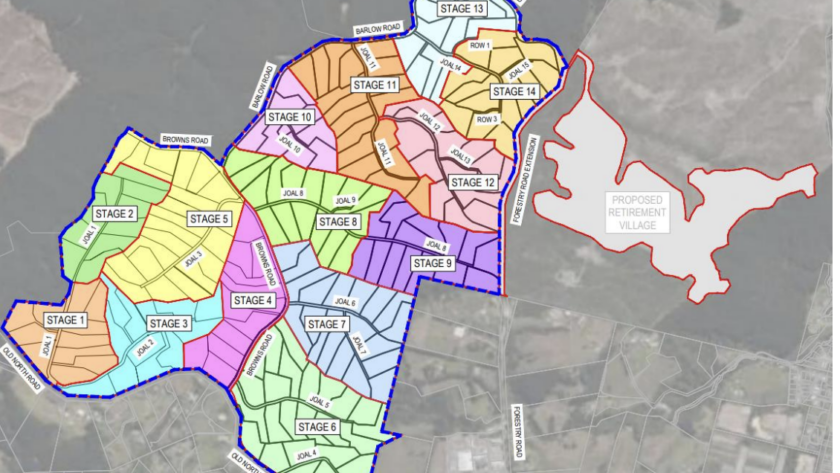
Subdivide land and develop approximately 210 residential allotments and an approximately 350-unit retirement village. Approvals granted 27 November 2025. The expert panel for the Rangitoopuni project granted approvals for the application, subject to conditions.
See the details of the development HERE
Bottom Line (Plain English)
The conditions:
- Control how they build
- Do not guarantee infrastructure keeps up
The biggest gaps are:
- No regional transport upgrades required
- No guaranteed wastewater solution
- Flood risk still present
- Staging not tied to capacity
Key Conditions Developers Must Meet
1. Staging and Sequencing Requirements
- The subdivision must follow strict staging order, with earlier stages completed before later ones.
- Certain stages must be completed before others can begin (e.g., stages 4, 5, 8 before later stages).
- Work can occur across multiple stages only if all consent conditions are complied with.
➡️ This prevents them from jumping ahead without infrastructure or environmental protections in place.
2. Design and Landscape Guidelines (Must be Approved)
- Before each subdivision stage, the developer must submit final Design and Landscape Guidelines.
- These must be certified by Council before proceeding.
- Guidelines must align with the Urban Design and Landscape Effects Assessment.
➡️ This controls visual impact, density, and rural character.
3. Survey Plans and Legal Requirements
For each stage, the developer must:
- Submit a survey plan showing roads, reserves, easements, and covenants.
- Include protective land covenants over restoration planting areas.
- Provide public access easements over walkways and cycleways.
- Provide easements for water, electricity, telecommunications, drainage and services.
- Pay all costs for easement creation and registration.
➡️ This ensures public access and infrastructure is legally locked in.
4. Vegetation and Environmental Protection
- Protective covenants must be placed over restoration planting areas.
- Revegetation and landscape areas must be legally protected long-term.
- Public access routes must be secured through easements.
➡️ This is meant to ensure planting isn’t removed later.
5. Wildlife (Lizard) Protection Conditions
Developers must:
- Follow a Lizard Management Plan throughout the project.
- Use qualified ecologists to survey, capture and relocate lizards.
- Monitor relocation sites and manage pests.
- Provide reporting and monitoring data.
- The approval can be revoked if conditions are breached.
➡️ This is legally enforceable ecological mitigation.
6. Design Controls on Future Buildings
Future lot owners (through developer rules) must:
- Build only within defined building platforms
- Maintain minimum yard setbacks
- Follow height limits
- Gain approval from a Design Review Panel
➡️ This keeps density and visual impact controlled.
7. Infrastructure & Access Requirements
Developers must:
- Create right-of-way easements for public access
- Provide infrastructure easements
- Register all easements on titles
- Pay costs for legal creation of infrastructure connections
What This Means in Practice
The developers cannot:
- Build everything at once
- Skip infrastructure
- Remove planting later
- Block public walkways
- Ignore ecological protections
They must:
- Build in stages
- Get council certification
- Protect vegetation legally
- Provide infrastructure and access
- Follow environmental management plans
The Big Picture
The conditions mainly focus on:
- Environmental protection
- Infrastructure delivery
- Public access
- Staging controls
- Landscape & design quality
- Wildlife protection
These conditions do not remove the development, but they attempt to manage its impacts.
1. Transport-Related Conditions
What developers must do
- Subdivision must follow staged sequencing, meaning transport access must be delivered progressively with each stage.
- Survey plans must show roads to vest in Council, meaning roads become public infrastructure.
- Public right-of-way easements must be created for walkways and cycleways.
- Infrastructure easements for services (water, electricity, telecommunications) must be legally registered.
What this means
- Roads must be built, but there is no requirement for wider regional transport upgrades.
- No condition requiring:
- new public transport
- road widening outside site
- intersection upgrades beyond access points
➡️ Transport mitigation is mostly internal, not regional.
2. Wastewater-Related Conditions
The application acknowledges:
- On-site wastewater treatment systems are proposed.
- Some wastewater infrastructure is located in flood-prone areas, requiring consent.
Key implication
- Wastewater is not connected to central network.
- It relies on on-site disposal fields.
➡️ This means:
- Long-term management responsibility
- Risk in extreme rainfall events
- No guarantee of regional capacity alignment
3. Stormwater / Flooding Conditions
The approval notes:
- Stormwater outfalls located in 1% annual floodplain.
- Roads and infrastructure also within flood-prone areas.
- Diversion of overland flow paths proposed.
These activities require discretionary consent because of:
- Flood risk
- Infrastructure in floodplain
- Retaining walls in flood zones
This tells us:
- Flood risk exists and is acknowledged
- Stormwater relies on engineering mitigation, not avoidance
- Overland flow paths will be altered
4. Weaknesses in the Conditions (Most Important)
This is the part that really matters.
Weakness 1 — No Regional Transport Requirement
- Conditions only cover internal roads
- No requirement for:
- SH16 improvements
- public transport
- regional capacity upgrades
➡️ Growth allowed without transport solution
Weakness 2 — Wastewater Not Fully Resolved
- On-site disposal proposed
- Located partly in flood-prone areas
- No requirement for connection to networked wastewater
➡️ Long-term risk remains
Weakness 3 — Stormwater in Floodplains
- Infrastructure allowed within flood-prone areas
- Flow paths modified
- Engineering mitigation relied upon
So the risk is managed, not removed
Weakness 4 — Staging Doesn’t Tie to Infrastructure Capacity
- Staging exists, but not linked to
- road congestion thresholds
- wastewater capacity
- downstream stormwater effects
➡️ Development can proceed even if systems overloaded
Note- this content is AI generated from the AEE and Developer Conditions documents found on the Fast Track site.