Kumeu Community Action’s Position on “WAIMAUKU WEST” Fast-Track acceptance into the approval process. https://www.fasttrack.govt.nz/…/Waimauku-West-notice-of…
Kumeu Community Action is concerned that the proposed Waimauku West fast-track development would place significant pressure on already constrained infrastructure across the Northwest, particularly transport, wastewater, and the Kaipara River catchment.
1. Transport – More cars onto an already constrained SH16 corridor.
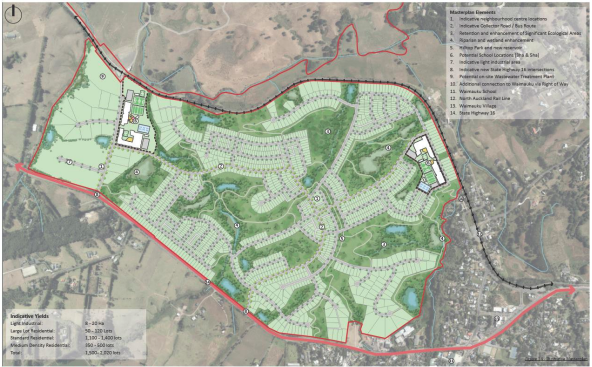
The proposal includes approximately 1,500–2,020 dwellings, along with commercial and school sites, in a rural location accessed primarily from State Highway 16.
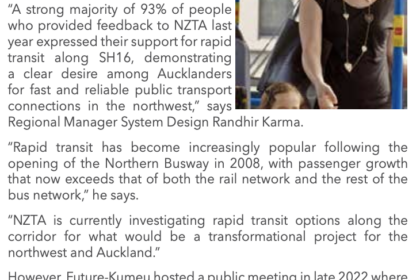
Consultation material notes that the development risks becoming “a relatively remote commuter suburb, with reliance on the private car for all trips”, and that there is no current or planned rapid or frequent public transport to Waimauku.
For Northwest communities already experiencing congestion between Waimauku, Huapai, Kumeū and Westgate, this would likely:
-Increase peak-time congestion on SH16
-Add pressure before planned transport upgrades are delivered
-Lock in long-term car dependency
-This runs counter to coordinated transport planning for the Northwest.
2. Wastewater – No public capacity and risk of private treatment discharge
Referral documents confirm that Watercare cannot service the development with public water or wastewater infrastructure, meaning a large onsite wastewater treatment plant would be required.
There are also concerns that failure during extreme weather events could increase environmental risk, and that the system could affect neighbouring properties through odour, noise, and operational issues.
For the wider Northwest, this raises concerns that:
-The development proceeds without planned regional infrastructure.
-Private systems introduce environmental risk
-Infrastructure sequencing for planned growth areas is undermined.
3. Effects on the Kaipara River and local waterways
Iwi feedback recorded in the referral material raises concern about proximity of wastewater infrastructure to the Kaipara River, noting that overflow or discharge could impact the mauri and wairua of the awa.
The Kaipara River system receives tributaries including the Waimauku and Kumeū streams and drains much of the Northwest catchment into the Kaipara Harbour.
This means any additional discharge or stormwater runoff from large-scale development could:
-Affect downstream water quality
-Add cumulative sediment and nutrient load
-Increase pressure on an already sensitive harbour catchment.
-Will almost certainly increase the runoff rate to the Kaipara River and raise the river flow upstream.
4. Lack of integrated infrastructure planning
The consultation material also states it is unclear whether the proposal integrates the necessary infrastructure, particularly given that public water and wastewater cannot be provided and stormwater and flooding concerns have been raised.
For the community, this creates concern that:
-Growth is being fast-tracked ahead of infrastructure
-Impacts are shifted onto existing residents
-The Northwest growth strategy is undermined.
Community Summary
From a Kumeu Community Action perspective, the Waimauku West fast-track proposal risks:
Increased congestion on SH16 and surrounding roads
A car-dependent commuter suburb without sufficient public transport.
Private wastewater treatment with potential environmental risks
Possible impacts on the Kaipara River catchment
Growth occurring ahead of coordinated infrastructure planning
In short:
This development introduces large-scale growth into the Northwest without the transport, wastewater, or environmental safeguards typically required, potentially shifting costs and impacts onto existing communities.
What Community Groups Can Still Do — With an estimated Timeline
STAGE 1 — NOW (Referral decision pending)
Waimauku West has passed the initial assessment and was referred by the Minister for Infrastructure to the fast-track approvals process on 2 March 2026
Timeframe: right now until Minister decides
What you can do
Send letters directly to Ministers (Infrastructure, Transport, Local Government)
Brief local MPs and Local Board members
Provide technical concerns (transport, wastewater, river impacts)
Request expert evidence from council, iwi, Watercare
Engage media and build community awareness
Why this matters
The Minister decides whether the project even enters fast-track. Once accepted, influence becomes narrower.
The Act explicitly states that if the Minister accepts the referral, the applicant can proceed to the substantive application stage.
This is the highest leverage point.
STAGE 2 — If Referral is Accepted
Timeframe: roughly 2–6 weeks after acceptance
What happens
Developer lodges full application
Agency checks completeness (about 15 working days)
Expert panel is set up
What community groups can do?
Request to be considered an affected party
Submit technical information to agencies (Watercare, Auckland Transport, Council)
Coordinate with iwi/hapū concerns
Prepare expert evidence (traffic, infrastructure)
You are trying to get included in the invited comment list
STAGE 3 — Panel comment period
Timeframe: approx. 1–3 months after referral acceptance
What happens
Panel invites selected parties only to comment
Hearing may or may not occur
What community groups can do
Provide structured technical submissions
Request to present at hearing (if held)
Provide evidence from engineers, planners, environmental experts
Coordinate joint submissions (more weight)
STAGE 4 – Panel decision phase
Timeframe: up to ~90 working days after comments close
Panels must generally issue decisions within a set timeframe, commonly up to 90 working days after comments are received.
What community groups can do
Limited actions
Engage media
Prepare for legal challenge (points of law only)
Practical Community Action Timeline
Week 0–2 (NOW)
Write Minister letters
Media statement
Contact MPs
Engage Local Board
Prepare briefing
Week 2–6
Request inclusion as affected party
Gather technical evidence
Coordinate with iwi
Meet with council staff
Week 6–12
Submit technical comments to panel
Request hearing
Provide expert reports
Month 3–6
Monitor panel decision
Media engagement
Consider legal options
The Most Effective Actions (Ranked)
Minister letters (NOW) — highest impact
Technical infrastructure evidence
Joint community + iwi position
Media framing around SH16 + Kaipara risk
Request to be an affected party
Straight-talk advice
You still have influence, but it drops quickly once the referral is accepted.
The next 2–4 weeks are the most important window.
Community groups are most effective when they:
-stay factual
-focus on infrastructure capacity
-avoid emotional or anti-growth framing
-highlight sequencing and risk to existing residents.